Intelligence Briefs
What your average rating hides across locations
A practical way to compare locations, separate a weak signal from a recurring problem, and turn customer feedback into a weekly operating decision.
By Mister Ripple ·
Interactive tools load with JavaScript. The article text and source links are available below.
Key takeaways
- A brand average can hide a struggling location. Compare the same source, time window and sample size before ranking teams.
- Use themes, case status and local context to choose an action, rather than treating stars as a complete diagnosis.
- Give each action an owner and a review date. Measure the operational change separately from review growth.
One healthy average. Three different realities.
A regional manager opens a report and sees 4.6 stars. The brand looks healthy. But the figure does not say which branch is losing customers, which complaint is spreading or which team has already fixed a problem. A summary is useful for orientation. It is a poor place to stop.
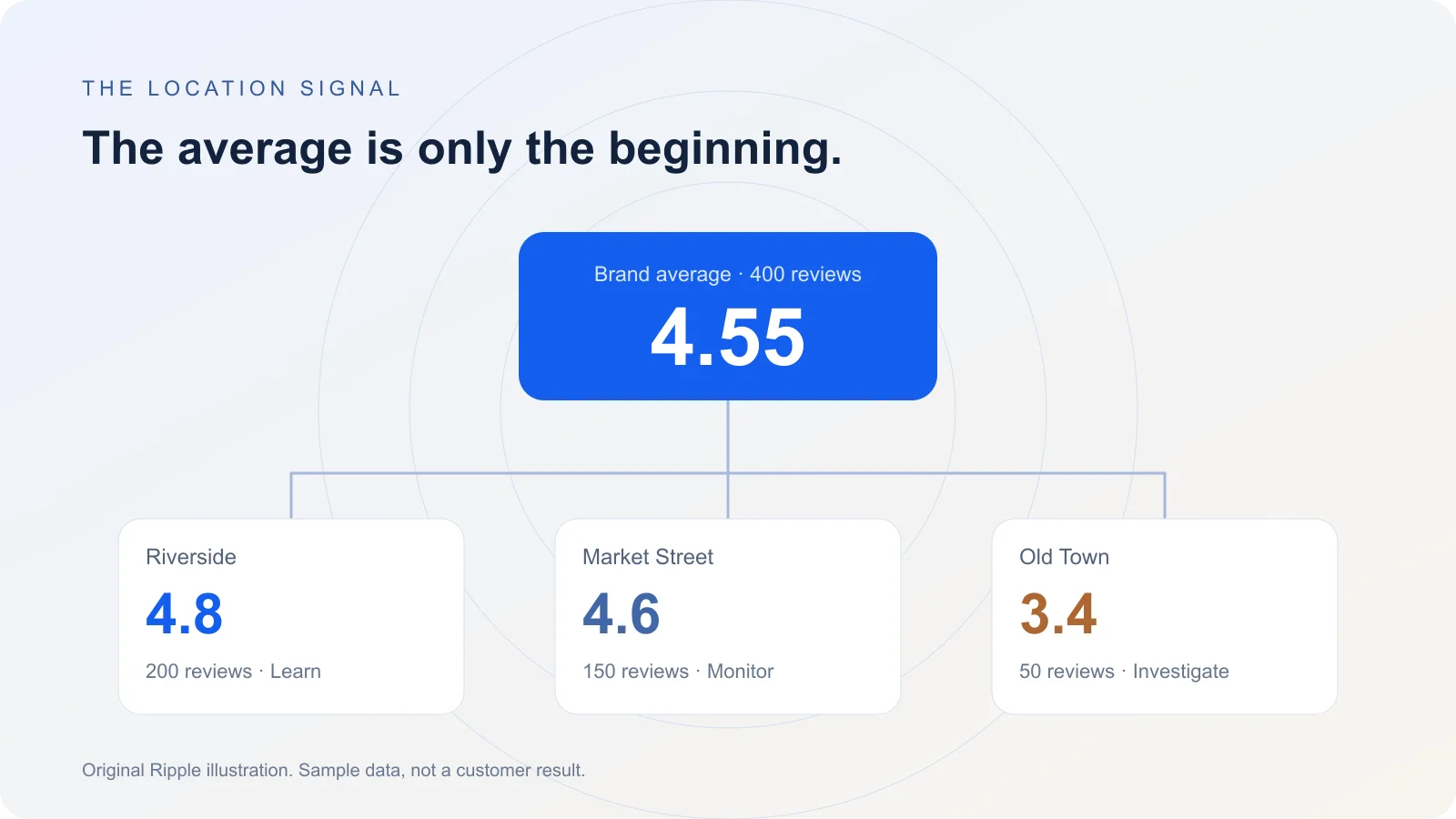
Consider an illustrative group with 400 public reviews in a matched reporting window. Riverside has 200 reviews averaging 4.8. Market Street has 150 averaging 4.6. Old Town has 50 averaging 3.4. Weighting those averages by their review counts gives 4.55, or 4.6 rounded to one decimal. A strong brand-level number can coexist with a branch that needs attention.
This is a teaching example, not a Ripple customer result. Its purpose is to show why the next click should open the locations behind the average. A simple average of the three branch scores would answer a different question because it gives a 50-review location the same weight as a 200-review location.
| Location | Review count | Average rating | First question |
|---|---|---|---|
| Riverside | 200 | 4.8 | What is working consistently? |
| Market Street | 150 | 4.6 | Which themes are changing? |
| Old Town | 50 | 3.4 | What needs investigation now? |
Make the comparison fair before making it dramatic
Start with one review source and one date range. Comparing one location’s lifetime Google score with another location’s last-month form feedback creates a league table that cannot support a fair decision. Public reviews, private submissions, scans and redemptions represent different events and different groups of people.
Keep the count beside the score. A small number of responses can swing a percentage sharply. A newly opened branch, a seasonal venue and a mature flagship also have different operating contexts. Show those differences instead of hiding them behind a red or green badge.
For a weekly check, compare the same recent window with the preceding window of the same length. Then inspect the underlying comments. A change may reflect a real service problem, a different customer mix, a collection change or only a handful of new reviews. The report should help your team ask a better question before it makes a bigger claim.
- Keep the source and review status consistent across locations.
- Use matching date windows and show the number of observations.
- Separate new locations, seasonal periods and campaign changes in the notes.
- Keep public-review metrics and private-feedback metrics clearly labelled.
Find the repeatable problem inside the comments
A rating tells you how someone evaluated the experience. The accompanying theme can tell your team where to investigate. Waiting, cleanliness, product quality, delivery damage and staff communication call for different owners and different fixes. One combined negative-sentiment score loses that distinction.
Use both the count and the share of feedback mentioning a theme. Eight waiting complaints among ten submissions should not be presented the same way as eight among two hundred. Equally, a low percentage at a large location can still represent many customers who need help. Read the comments and consider severity alongside frequency.
Where shift or team context exists, use it to understand conditions and support a fair conversation. Feedback alone does not prove who caused an issue. An evening pattern might reflect staffing, demand, a delivery bottleneck or how feedback is collected. Investigate with the people who were there.
Turn a leaderboard into an operating decision
A useful location review ends with a small decision. At Old Town, for example, repeated mentions of waiting could lead the manager to observe the pickup handoff during the busiest period. At Riverside, the question might be which part of that handoff works well enough to share with the other teams.
Choose one change and define what would count as progress. If the team changes pickup signage, record when it changed. Revisit waiting-related feedback in the next comparable window, and look at the counts as well as the percentage. Do not call an improvement causal just because the chart moves afterward.
Ripple’s location-level feedback, topic analysis, alerts and case management can support this routine. The point is not to create more dashboards for a manager to watch. It is to connect the relevant customer signal to a person who can act and a date when the team checks what happened.
| Signal | Investigation | Owner | Follow-up evidence |
|---|---|---|---|
| Waiting mentioned repeatedly | Observe pickup and queue handoff | Location manager | Theme count, share and comments in the next matched window |
| Packaging damage across products | Review packing and handling context | Operations or product team | New damage reports by product and period |
| Same issue keeps reopening | Read the case timeline and proposed fix | Customer-service lead | Repeat cases and customer-confirmed outcomes |
Handle the individual while you investigate the pattern
A recurring theme belongs in the operating review. An individual customer with a problem may need help now. Do not make them wait for a larger sample or a monthly presentation before someone responds.
In Ripple’s usual form journey, a rating of three stars or below reveals optional issue details and a checkbox consenting to contact about the problem. That creates a direct support opportunity when the customer chooses it. Marketing consent is separate, and public review routing remains available at every rating.
Track the case outcome honestly. Contact attempted, customer reached, action taken and resolution confirmed are different states. Closing an internal ticket does not necessarily mean the customer agrees that the matter is resolved. A later review update remains the customer’s decision; help must never depend on a higher rating.
Keep review growth and visibility in the right context
Public reviews matter beyond the report. Google says local results are based mainly on relevance, distance and prominence, and that more reviews and positive ratings can help local ranking. That makes a consistent review opportunity worth building into the customer journey. It does not make any particular placement predictable.
Keep the operational goal and the review-growth goal visible side by side. A branch can earn more reviews while an issue remains unresolved. Another can fix an operational problem before its public average moves appreciably. Treat both as useful evidence, with their own timeframes.
Google’s policies prohibit incentives in exchange for posting, changing or removing reviews, and prohibit selectively soliciting positive reviews. Keep a benefit independent of review completion or rating, preserve the public path for every rating and check the campaign against the destination’s current requirements. A routing setting is not a blanket compliance guarantee.
A weekly location brief your team can actually use
Start with three locations rather than every possible chart. Bring the same five items to the meeting: source and date range, count and score, leading themes, unresolved cases, and the action being tested. Give the manager enough context to explain what the chart cannot.
A first-week rollout might take one recurring issue, name an owner and establish the baseline. In the second week, review what changed and what customers are saying. In the third, decide whether the action should continue, be revised or be shared. This is an example operating cadence, not a promised performance timeline.
The outcome you want is a better decision made sooner. Review growth, customer relationships and repeat engagement become more useful when the team understands where they are happening and what to do next.
- Choose a source, date range and three comparison locations.
- Put the observation count next to every rate or average.
- Pick one recurring theme and inspect its underlying comments.
- Assign a practical action, an owner and a review date.
- Follow up with consenting customers through the issue workflow.
- Review the next matched window and document limits as well as progress.