Practical Guides
The weekly local visibility check: reviews, actions and evidence
A practical weekly check for local operators: separate public reviews, Google Business Profile interactions and actual customer outcomes, then choose one evidence-backed next action.
By Mister Ripple ·
Interactive tools load with JavaScript. The article text and source links are available below.
Key takeaways
- Give review activity, profile discovery and customer outcomes their own measures.
- Keep the location, reporting window and source visible in every comparison.
- Fix a broken customer path before making a claim about search performance.
- Ask for genuine feedback without filtering customers by sentiment.
Start with the question the report needs to answer
A manager wants to know whether the new review program is helping customers find the business. The team opens a dashboard, sees more reviews and declares that local visibility improved. That conclusion skips a step: a review count records something different from a search appearance, and neither is a completed visit.
Start the weekly meeting with a specific question. Are customers reaching the correct review page? Are genuine reviews appearing on that location’s public profile? Are people discovering the profile or taking useful actions from it? Are those actions becoming bookings or sales? Each question needs a different source.
This is a working review routine, not a ranking formula. Its purpose is to leave the team with a defensible observation and an action someone owns.
Keep three evidence lanes
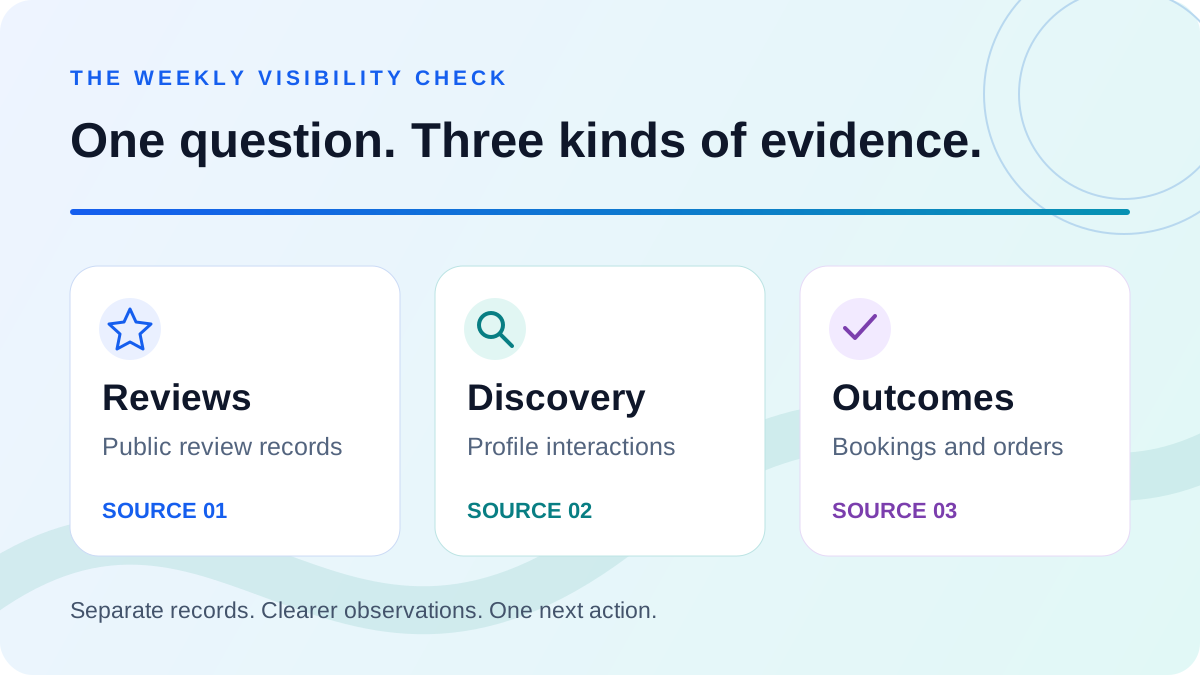
Use three small sections in the handoff instead of one blended score. In the first, record the customer journey and public reviews. In the second, record the profile’s discovery and interaction measures. In the third, record completed customer outcomes from the system that actually holds them.
A campaign redirect means the customer reached the next destination. It does not confirm a published Google review. Likewise, a new public review can be observed on the intended profile without proving that a particular QR scan produced it. If you cannot link the records, keep them separate.
Decide in advance what “new review” means. A difference between two snapshots is net count change, not necessarily the number of new reviews received. Removal or moderation can affect the total. Save the original count and extraction date so someone else can reconstruct the observation.
| Evidence lane | Record | Keep this boundary |
|---|---|---|
| Review activity | QR destination check, published review count, source and observation time | A redirect is not a published review |
| Profile discovery and actions | Available profile views, calls, website clicks or directions for a named period | A profile action is not automatically a completed visit |
| Customer outcomes | Completed bookings, attended appointments or paid orders from the appropriate system | An outcome is not automatically attributable to the review program |
Check the listing before the review request
For each location, open the destination as a customer would. Confirm the business, address and review form. Then ask the person responsible for the Business Profile to check its factual details, particularly the services or category, opening hours and customer-facing address.
Google identifies relevance, distance and prominence as key local ranking factors. Its guidance says complete information helps it understand a business, and reviews and positive ratings can support local ranking. It also says businesses cannot request or pay for a better local ranking. A review program should therefore sit inside a broader location check, without promising a particular position.
Keep a correction log. “Saturday hours corrected by the profile manager” is useful operational evidence. “We optimized Google” is too vague to tell the next manager what changed.
Use the actual profile metric definitions
Google Business Profile performance offers discovery and interaction information for verified profiles, with the metrics available depending on the business. The report can include organic and Google Ads activity. A call measure counts clicks on the profile’s call button; website clicks count clicks on its website link. Neither definition establishes a completed transaction.
Use the same location and period when comparing those measures. Record whether advertising was running and whether availability, hours, website links or booking arrangements changed. Google says search-query reporting updates monthly and can take several days to appear, so a weekly meeting should use the latest available query period rather than invent a fresh weekly search-term total.
Do not turn a few manual searches into a market-wide rank score. If you keep a search observation, record the exact query, search location, device and time. Label it as a spot check. Consistent records make a comparison easier to inspect; they do not remove every source of variation.
A fictional weekly meeting, with a useful conclusion
Imagine a fictional two-location café team. The first location has nine more public reviews than at the previous snapshot. Its reported website clicks rose during the selected comparison periods. A paid promotion also started, and Saturday opening hours were corrected.
The safe report is: “We observed net review growth and more profile website clicks in these periods. Advertising and a listing correction also changed.” The team cannot isolate the review program’s contribution from those observations alone.
At the second location, the QR opens the wrong branch’s review page. The immediate action is to correct the configured destination and test the customer path. Increasing the number of requests before fixing that path would make the operating problem larger.
No outcome in this example is a Ripple customer result or forecast. The example illustrates how a weekly meeting can produce a concrete decision without manufacturing a ranking or revenue claim.
Ask and respond without trying to shape the rating
Use a neutral request such as “Share your experience with our team.” Make the public destination available at every rating, alongside any optional private support route. Do not ask only apparently satisfied customers, pressure people to review on the premises or dictate keywords for their review.
Google’s current Maps policies prohibit selectively soliciting positive reviews and benefits offered in exchange for reviews or their revision or removal. Keep benefits and service recovery independent of public review participation.
Give responses an operational purpose: answer a useful question, acknowledge a specific issue or explain the next contact step. Google advises relevant, professional replies and keeping private details out of public responses. Do not promise an immediate resolution your team cannot provide.
Sources: Google Maps: genuine engagement and rating manipulation; Google: review requests and reply guidance
Put Ripple in the right part of the routine
Use Ripple’s configured customer journeys and campaign links to make a relevant feedback opportunity easier to reach. Confirm the location and destination, then review the feedback and optional support follow-up in the appropriate workspace.
For Google review imports and supported direct replies, the correct account and location connection and permissions matter. A working Google review URL is not the same as a connected Business Profile. Use the Google connection guide and review workspace guide when checking that setup.
Keep the feedback workflow alongside source-specific performance reports and actual booking or order evidence. Give each source its own owner and extraction date so the next person can check the observation.
Leave one action for the next review
Before ending the meeting, complete this handoff:
If the destination is wrong, fix it. If an unanswered review exposes an operating issue, assign the follow-up. If booking completion is unknown, improve that evidence before claiming growth. If the observations are mixed, retain them and check the next comparable window.
Start with the review QR print checklist for the physical customer path, or explore Ripple’s hospitality journeys to connect the routine to a real location workflow.
- Location and source: which public profile and campaign did we check?
- Reporting window: which dates, time zone and extraction date apply?
- Observation: what changed in reviews, profile actions and customer outcomes, separately?
- Other changes: did ads, hours, availability or customer volume change?
- Decision: what single action, owner and follow-up date did we agree?